
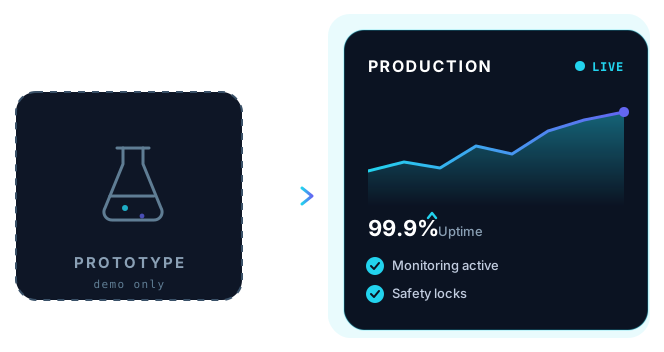
An impressive AI demo can be built in just a few days. You connect a language model to a bit of sample data, write some clever instructions, show three successful runs – and the room is thrilled. This is exactly where a dangerous misunderstanding takes hold: the demo looks like the finished product. In reality, it is only the beginning. The real effort, the real skill and the real value lie in the leap from the demo to a reliable production system. This article explains why demos deceive, what production readiness concretely means, and what it takes to turn a prototype into AI software that does real work every day.
Why demos deceive
A demo is almost always shown on the so-called happy path: hand-picked inputs, clean sample data, a single user, no time pressure. Under these conditions, nearly any AI system looks brilliant. Real operation looks different. There, incomplete requests, contradictory details, typos, foreign languages, empty fields and unexpected formats hit the system – all at once, in large numbers and around the clock.
The crucial gaps between demo and reality can be named clearly:
- Edge cases: the rare, odd, unforeseen situations that appear in no demo, yet show up constantly in everyday use – and often cause the most expensive failures.
- Load: a hundred simultaneous requests behave differently from one. Response times, costs and error rates do not rise linearly, but often in sudden jumps.
- Data quality: in the demo the data is curated. In operation it is outdated, incomplete, duplicated or simply wrong – and that is exactly what the system has to deal with.
- Continuous operation: a demo runs for five minutes. A production system runs for months without anyone watching.
Anyone who underestimates these gaps builds a system that shines in the pilot and disappoints in real operation. That is precisely why the demo is never the goal, only the proof of feasibility.
In short: a demo proves that something works in the best case. A production system proves that it does not fail uncontrollably in the worst case. Between the two lies the actual engineering work.
What production readiness really means
Production readiness is not a single feature, but the sum of properties that make a system reliable, controllable and trustworthy. At its core it is about these building blocks:
- Reliability & uptime: the system is available when it is needed – with defined targets, redundant flows and a plan for when external services fail.
- Monitoring & logging: every operation is logged traceably. You can see in real time what the system does, how fast it responds and when it deviates from normal behaviour.
- Error handling: when a step goes wrong – a service does not respond, an answer is unusable – the system catches it in a controlled way instead of silently delivering wrong results.
- Safety and approval locks: critical actions need clear boundaries and, at sensitive points, a human approval before they are carried out.
- Cost control: every request to a model costs money. Without budgets, limits and transparency, a useful helper quickly turns into an unpredictable expense.
- Evaluation & quality measurement: the quality of the outputs is measured systematically and repeatably – not by gut feeling, but against defined test cases.
- Versioning & rollback: every change to instructions, models or logic is traceable – and in an emergency the previous state can be restored immediately.
Only when these properties come together does a clever prototype become a system you can entrust with real work without constant supervision.
| Aspect | Demo / prototype | Production system |
|---|---|---|
| Inputs | Hand-picked examples | Everything that actually arrives |
| Error cases | Avoided | Caught in a controlled way |
| Load | One user, one run | Many parallel requests, continuously |
| Observability | Visual check | Monitoring, logging, alerts |
| Quality | "Looks good" | Measured against test cases |
| Cost | Negligible | Budgeted and monitored |
| Changes | Directly in the code | Versioned, with rollback |
| Responsibility | System decides alone | Human in the loop at critical points |
Integration into existing systems and data
An AI system does not live on its own. It only unfolds its value when it is connected to the systems where the real work happens: CRM, ERP, ticketing, knowledge base, mailbox. This very integration is usually only hinted at in the demo – but in production it is a substantial part of the effort. Interfaces have to be authenticated, secured and cushioned against outages. Data has to flow in the right form, at the right time and at the right permission level.
On top of that comes data quality: an AI-Agent that accesses a messy CRM inherits its errors – only faster and at greater scale. Production readiness therefore also means checking the data foundation, detecting duplicates and gaps, and defining how the system deals with uncertain or missing information.
Human in the loop at critical points
Full autonomy sounds tempting, but it is rarely the right first step. Reliable AI software deliberately defines where a human approval sits: before a binding email goes to a customer, before a payment is triggered, before a record is changed irreversibly. These control points are not a sign of weakness but an expression of good engineering – they make the system auditable and build trust.
The level of maturity shows in how finely this loop is tuned: routine cases pass through automatically, while only the sensitive, uncertain or particularly consequential operations are presented for confirmation. This preserves the efficiency gain without losing control.
The real task: the bottleneck is not the AI that shines in the best case – it is the system around it that stays predictable even in the worst case. Whoever invests in monitoring, error handling, approvals and evaluation turns an impressive demo into a tool you can trust every day.
Operation and maintenance
A production system is never "finished". Models are updated, deprecated or replaced by better ones. Providers change prices, terms and interfaces. Data shifts, and with it the behaviour of the system. Production readiness therefore means planning for maintenance from the start: models and providers must be replaceable without rebuilding the entire system. This is exactly where versioning, evaluation and a clean rollback pay off – they make change manageable instead of risky.
This also includes continuously watching quality: a system that delivered good results yesterday can quietly get worse after a model change or a data update. Only those who measure continuously notice such a decline before it becomes a problem in daily business.
Data protection and security
In production at the latest, real and often personal data flows through the system. This turns data protection and security from optional into mandatory. Who has access to which data? Which information leaves the company, and to which services? How long are logs kept, and how are they protected? Production-ready AI software answers these questions before launch – with clear permissions, data-minimising processing, secure transmission and traceable logs that are GDPR-compliant.
Precisely because AI systems process large volumes of data quickly, they also multiply the consequences of a vulnerability. Security is therefore not an afterthought bolted on later, but a foundation that has to be considered from the very beginning.
Conclusion
The demo answers the question "Is it possible?". The production system answers the far more important question "Can we rely on it every day?". Between the two lies the real work: reliability, monitoring, error handling, approvals, cost control, evaluation, versioning, clean integration, thoughtful maintenance, plus data protection and security. Whoever underestimates this leap stays stuck in eternal pilot mode. Whoever takes it seriously turns an impressive AI demo into a reliable system that does real work – day after day, even when no one is watching.
Sources & further reading
- Google Cloud: MLOps – continuous delivery and automation in machine learning
- Regulation (EU) 2024/1689 (AI Act) – incl. human oversight, EUR-Lex
- Cogitavo magazine: AI-Agents in your company
- Cogitavo magazine: RAG explained
Linked sources as of June 2026. This article is for general information and is not legal advice.