
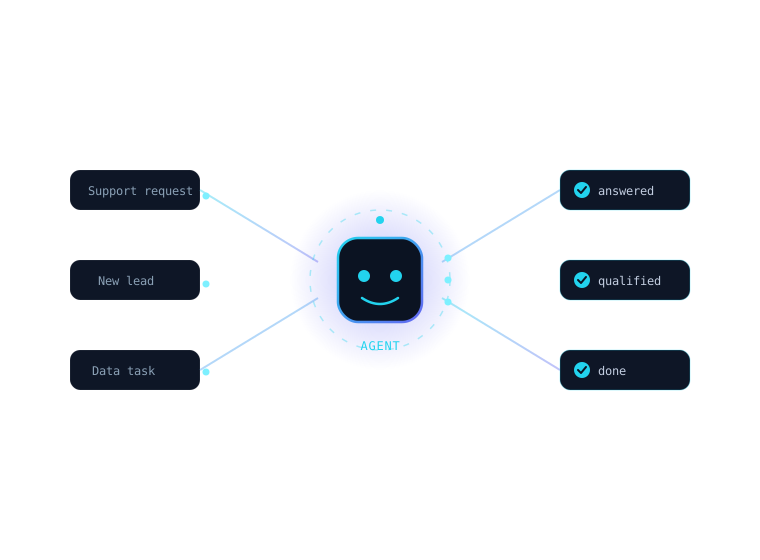
Hardly any term is currently used as often – and understood as differently – as "AI-Agent". For some it is a clever chatbot, for others a fully automated workforce made of software. The truth lies in between, and that is exactly where it gets interesting for companies. This article explains, in plain language, what AI-Agents really are, how they differ from classic automation, where they create real value today – and where their limits lie.
What is an AI-Agent – and what is it not?
A classic chatbot answers. An AI-Agent acts. The difference sounds small but is decisive. An AI-Agent combines a language model (which understands and formulates) with the ability to use tools: it can query a database, send an email, create a calendar entry or call an interface. Above all, it works goal-oriented: it receives a task, breaks it into steps, executes them, checks the result and decides what is needed next.
This makes an agent fundamentally different from rigid automation. Classic automation follows a hard-wired flow: "If A happens, do B." An AI-Agent, by contrast, can deal with incomplete information, unexpected wording and new situations – because it is not told every step, but works towards a goal.
In short: Automation does the same thing very reliably. An AI-Agent decides for itself – within clear boundaries – which step makes sense next, which makes it strong wherever tasks vary.
How an AI-Agent works through a process
Imagine an agent that handles incoming enquiries in sales. Its flow might look like this: it reads the enquiry, fills in missing information from the CRM, qualifies the contact against defined criteria, drafts a suitable reply, creates a quote if needed and proposes an appointment. Each of these steps is logged traceably, and at critical points – for example before a binding email goes out – a human approval can be built in.
It is exactly this interplay of autonomy and control that makes agents usable in production. They take over the legwork but keep clear guard rails: what may the agent do alone, where must a human confirm, and what is off limits?
Where AI-Agents bring real value today
AI-Agents are not a cure-all – but in the right areas they save noticeable time. They are particularly valuable where many similar but not identical tasks occur:
- Customer service: answer standard questions around the clock, qualify requests and hand over to a human when needed.
- Sales: enrich and qualify leads, draft first replies and coordinate appointments.
- Back office: read documents, transfer data into systems, trigger routine processes.
- Research & reporting: gather information from several sources and present it clearly.
The common denominator: tasks that cost a lot of manual time today, are describable clearly enough, and where errors can be caught through control.
Where the limits are
Just as important as the strengths are the limits. AI-Agents work probabilistically – they produce the most likely answer, not guaranteed the correct one. This has clear consequences for responsible use:
- Control remains necessary: legally, financially or safety-critical steps call for human approval.
- Data quality is decisive: an agent is only as good as the information and interfaces it can access.
- Clear boundaries instead of unlimited autonomy: good agents have a narrowly defined remit – which makes them reliable and auditable.
Rule of thumb for getting started: begin with a clearly defined use case that involves a lot of manual effort and manageable risk. This quickly creates measurable value – and trust for the next steps.
How to get started
The most common mistake is to start too big. Successful AI-Agent projects start small: one concrete process, a measurable goal, clear approval and safety levels. Once the first agent is in production and demonstrably delivers results, it can be extended step by step – with new tasks, additional interfaces or further agents that work together.
Clean integration into the existing IT is essential here: an agent only unfolds its value when it may access the right data and systems – in a data-protection-compliant, secure and traceable way. This is exactly the difference between an impressive demo and a system that reliably does work every day.
Conclusion
AI-Agents are neither magic nor pure marketing. They are a practical tool to automate recurring, varying tasks with good judgement – with clear boundaries and human control in the right places. Anyone who starts with a focused use case quickly gains experience, saves time and lays the foundation to make AI productive in their own company, step by step.
Sources & further reading
- European Commission – Regulatory framework for AI (AI Act)
- Regulation (EU) 2024/1689 (AI Act), EUR-Lex
- Cogitavo magazine: The EU AI Act 2026 at a glance
- Cogitavo magazine: AI & GDPR
Linked sources as of June 2026. This article is for general information and is not legal advice.